A research team led by Professor Yanni Yu from the Weihai Institute for Interdisciplinary Research of Shandong University, in collaboration with the National University of Singapore, has published a research article titled “Impact of early-life exposure of children to expanded road infrastructure on long-term educational attainment: New evidence from China” in the leading economics journalEconomic Analysis and Policy.
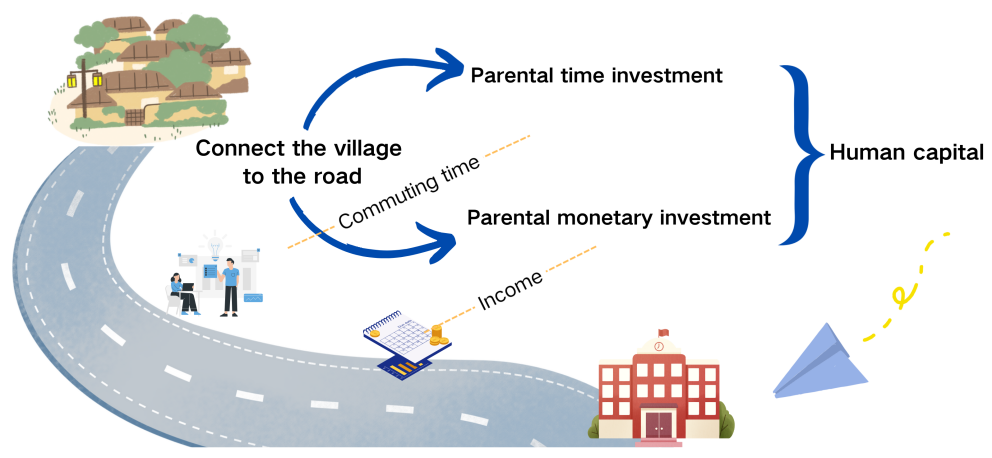
Graphical Abstract
The first author of the paper is Xin Meng, a PhD candidate at the institute, and Professor Yanni Yu serves as the corresponding author.
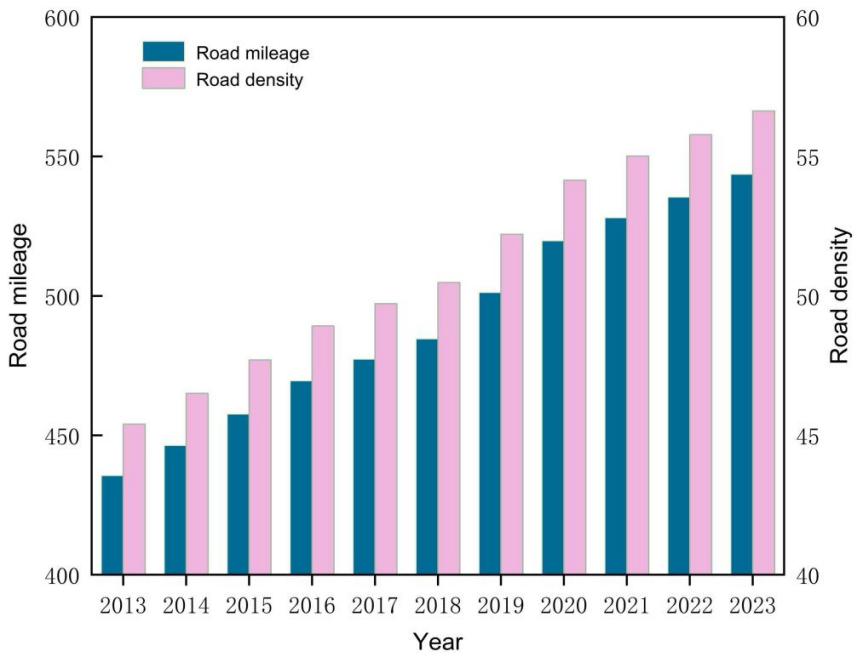
Figure 1.Road mileage and density in China from 2013 to 2023.
Source: The data were obtained from the Ministry of Transport of China.
The United Nations2030 Agenda for Sustainable Developmentexplicitly states the need to “ensure inclusive and equitable quality education and promote lifelong learning opportunities for all.” However, in many developing countries, children’s educational opportunities are largely influenced by road accessibility during early life stages, as children are more sensitive to environmental factors during this period than adults. In this context, as one of the most populous developing countries in the world, China has expanded its road infrastructure. At the same time, the government has incorporated Sustainable Development Goal 4 into its national education modernization strategy and emphasized inChina Education Modernization 2035that educational equity should be a key policy priority. With large-scale capital investment driving the expansion of road infrastructure, the central question that remains to be answered is: how does early-life exposure of children to improved road infrastructure influence their educational attainment?

Figure3.Event study.
Notes:The figure displays the coefficients and 95% confidence intervals from the event study analysis. Time period-1is used as the base group, so the estimates for the other time periods are relative to this point.
This paper uses the China Family Panel Studies (CFPS) data and employs a cohort difference-in-differences (DID) method to explore the influence of early-life exposure to improved road infrastructure on long-term educational attainment. We find that experiencing road infrastructure improvements before the age of five increases years of schooling by 0.539 years. Women, rural residents, and individuals with less parental education or limited geographical accessibility benefit more from positive influences. We further investigate the mechanisms through which road infrastructure influences educational attainment. The results suggest that improved road infrastructure enhances parents’ investment of time and money in their children, both of which contribute to higher educational attainment. These findings provide new empirical evidence for understanding the relationship between infrastructure development and human capital accumulation, and also offer valuable policy insights for other developing countries.
This research was funded by the National Natural Science Foundation of China (72473083), the China Scholarship Council (202306220194), and the Keppel Care Foundation (Singapore) for the award of the Kepper Professorship (E-462-66-0045-04/05).
Article link:
https://www.sciencedirect.com/science/article/pii/S0313592626000500


 Address: No. 180 Wenhua West Road, Weihai City, Shandong Province, China
 Tel:+86-0631-5688246
 Email: whqyy@sdu.edu.cn

