Recently, after more than a decade of intensive research, the team led by Professor Jian Liu from Weihai Institute for Interdisciplinary Research, Shandong University, in collaboration with the computational mathematics team from Beijing Jiaotong University, has successfully established a general canonical guiding center theory independent of the specific form of the magnetic field. This achievement has paved a new path for the fundamental research and applications of guiding center dynamics and gyrokinetics in magnetized plasmas.
Entitled "Canonical Hamiltonian guiding center theory and classical intrinsic magnetic moment", the relevant findings were published in Frontiers of Physics (Front. Phys.), a prestigious comprehensive physics journal, and have garnered widespread attention from the international academic community. Professor Jian Liu from Shandong University serves as the corresponding author of the paper, Associate Professor Rui-Li Zhang from Beijing Jiaotong University as the first author, and Professor Xiao-Gang Wang, adjunct chair professor at Shandong University, as the key collaborator.
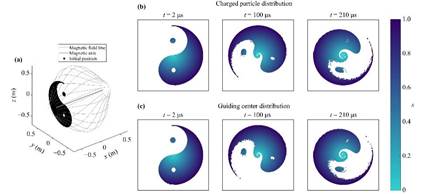
Figure 1. (a) The initial 3D distribution of charged particles and guiding center particles in the magnetic mirror with electric field
 . The spatial distributions projection in the y-z plane of charged particles and guiding center particles at three moments
 are plotted in subfigures (b) and (c), respectively. The color bar forsindicates the corresponding normalized magnetic flux value.
Guiding center dynamics is a key topic for describing and addressing multi-scale problems in magnetized plasmas, providing a crucial theoretical foundation for frontier fields such as controlled nuclear fusion, space physics, and astrophysics. To date, the plasma guiding center theory widely adopted is still based on the guiding center Lagrangian system proposed by Littlejohn in the early 1980s. Despite continuous efforts by many renowned plasma physicists to establish a complete canonical guiding center theory, traditional canonical methods have long been confined to the reduced four-dimensional phase space and highly dependent on the specific form of the magnetic field, making it difficult to form a universal theoretical framework. This bottleneck has not only severely restricted the completeness of guiding center theory but also hindered the establishment of long-term and accurate gyrokinetic descriptions for complex magnetized plasma systems. Furthermore, it has posed a fundamental obstacle to exploring the physical structure of guiding center systems and developing numerical algorithms with excellent structural properties.
To address this core scientific challenge, Professor Jian Liu's team fully leveraged the advantages of interdisciplinary collaboration, integrating plasma physics and computational mathematics. By comprehensively utilizing multidisciplinary theoretical approaches such as gyrokinetics, Hamiltonian systems, and multi-scale analysis, the team conducted continuous research efforts. They adopted two different derivation methods and obtained three equivalent canonical expressions of guiding center dynamics, laying a solid foundation for the systematic development of guiding center symplectic algorithms and canonical gyrokinetics.
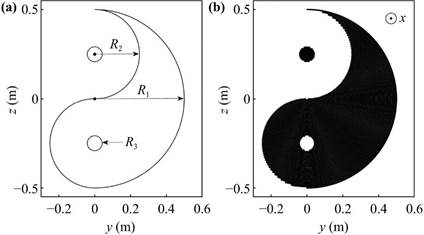
Figure 2. The structure of the Tai Chi diagram region. (b) The initial spatial distribution of samples in the
 plane. The ⊙
 Indicates that the direction of the x-axis is perpendicular to the paper surface and points outward.
This work derives a new guiding-center Lagrangian via two independent methods, first demonstrating that guiding-center dynamics form a canonical Hamiltonian system with two constraints in six-dimensional phase space, yielding three equivalent expressions. A clear "pseudo-particle" model beyond gyro-scale was established, making the dynamics self-consistent and physically complete. The study reveals the origin of the intrinsic magnetic moment from a multi-scale modeling perspective.
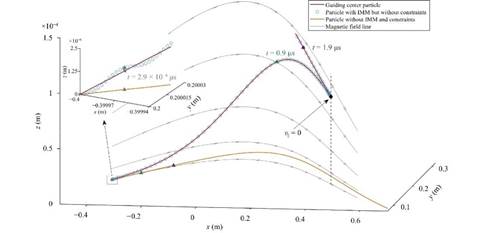
Figure 3. The trajectories of three different systems in a magnetic mirror field for comparison. The red curve depicts the trajectory of the canonical guiding center system. The orange curve depicts the trajectory of the system without IMM or constraints. And the light blue circles trace the orbit of the system with the complete Hamiltonian but without constraints. The triangles with different colors expose the spots of the three systems at different times, respectively. The zoomed-in window exhibits details of the fast timescale dynamics of the system with IMM but without constraints.
The canonical framework clarifies the symplectic structure, enabling development of structure-preserving algorithms. Simulations in magnetic mirror fields show the symplectic mid-point method maintains minimal energy error in long-term simulations, unlike conventional algorithms where error accumulates. This approach enables accurate long-term simulation of guiding-center motion in complex fields, supporting magnetic confinement optimization in nuclear fusion devices. The theory also underpins canonical gyrokinetics and structure-preserving PIC algorithms.
Original link: https://doi.org/10.15302/frontphys.2026.026200
As an emerging interdisciplinary field with the deep integration of artificial intelligence and basic science, scientific intelligence accelerates scientific discovery, solves complex scientific problems, drives paradigm change in scientific research, and promotes the sustainable development of artificial intelligence through discipline integration. Scientific intelligence has shown unique advantages and broad prospects in dealing with complex system problems, and has important value for basic research and major applications. In various basic research fields such as mathematics, physics, computational science, chemistry, and biology, as well as strategic application directions such as fusion energy, deep space exploration, and advanced manufacturing, scientific intelligence has received more and more attention. Many national big science installations and international big science programs are actively promoting the construction of digital and intelligent platforms. From the perspective of both material science and information science, scientific intelligence is the frontier direction of vigorous development.


 Address: No. 180 Wenhua West Road, Weihai City, Shandong Province, China
 Tel:+86-0631-5688246
 Email: whqyy@sdu.edu.cn

