Recently, a research team from the Institute of Blue and Green Development, Weihai Institute for Interdisciplinary Research, Shandong University has made the latest research progress in uncovering the market penetration and environmental benefits of emerging photovoltaic (PV) technologies. Research findings, entitled “Photovoltaics development pathway and environmental benefits dynamics from technological evolution in China”, have been published online inEnvironmental Impact Assessment Review. Zhu Guyu, a Master’s student, and Xin Yu, a Postdoctoral Fellow, both from Weihai Institute for Interdisciplinary Research, are the co-first authors of the paper. Associate Professor Ma Xiaotian and Professor Zhong Honglin serve as the co-corresponding authors, with Shandong University as the first affiliated institution.
As a primary clean energy source in China’s pursuit of “dual carbon” goals, the PV industry has witnessed rapid growth in installed capacity and technological advancement. Particularly, emerging PV technologies represented by perovskite, featuring low cost, high energy conversion efficiency, and simplified materials and manufacturing processes, will bring about profound structural changes within the PV industry. However, existing studies have not systematically evaluated the potential market and environmental impacts of emerging perovskite PV technologies, and they lack prospective considerations, which may lead to systematic biases in the environmental impact assessment of the future PV industry development.
By integrating PV market dynamics with prospective life cycle assessment (LCA), this study developed a coupled GCAM-PLCA model to predict the deployment scales of perovskite PV and existing PV technologies, identify key factors of technological evolution and potentials for environmental impacts reductions at each life cycle stage, and accurately assess the market penetration and environmental benefits of emerging perovskite PV technologies under different scenarios.
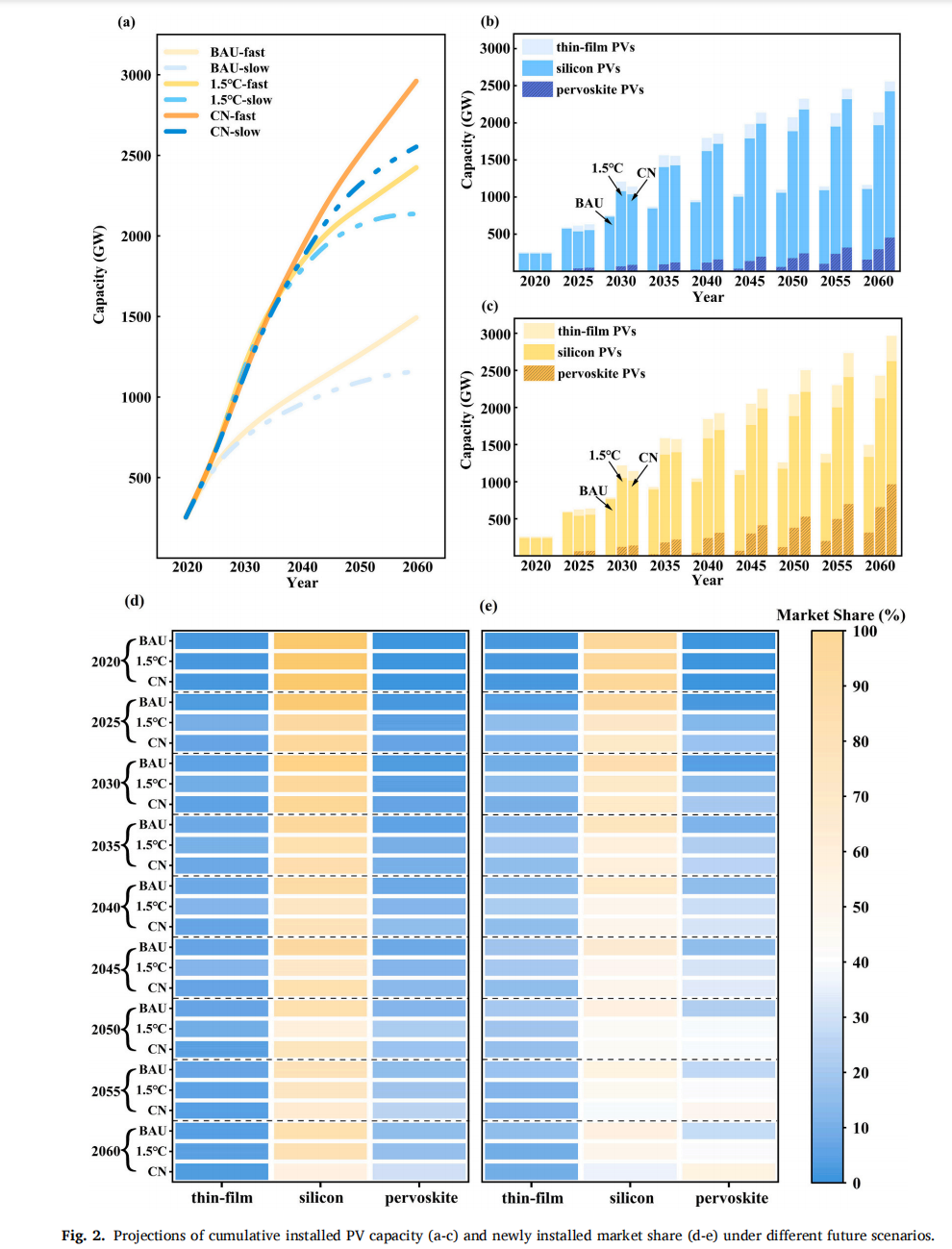
Fig. 1. Projections of cumulative installed PV capacity (a-c) and newly installed market share (d-e) under different future scenarios.
The research results indicate that perovskite PV will gradually replace crystalline silicon and thin-film PV. Especially under scenarios with stricter climate mitigation targets and faster cost declines, perovskite PV will account for 55.2% of the newly installed capacity (Figure 1). Among all perovskite PV technologies, the environmental impact of perovskite/Mono-Si technology is much higher than that of other types, while perovskite/TiO₂ technology exhibits the lowest impact (Figure 2). Across all PV technologies, freshwater ecotoxicity and global warming potential contribute the most to environmental impact, accounting for 63.4%-91.8% and 4.8%-20.5% of the total, respectively. These two major environmental impacts are mainly derived from aluminum (77.6%-90.8% of freshwater ecotoxicity) and CO2emissions from fossil fuels (68.4%-93.5% of global warming potential).
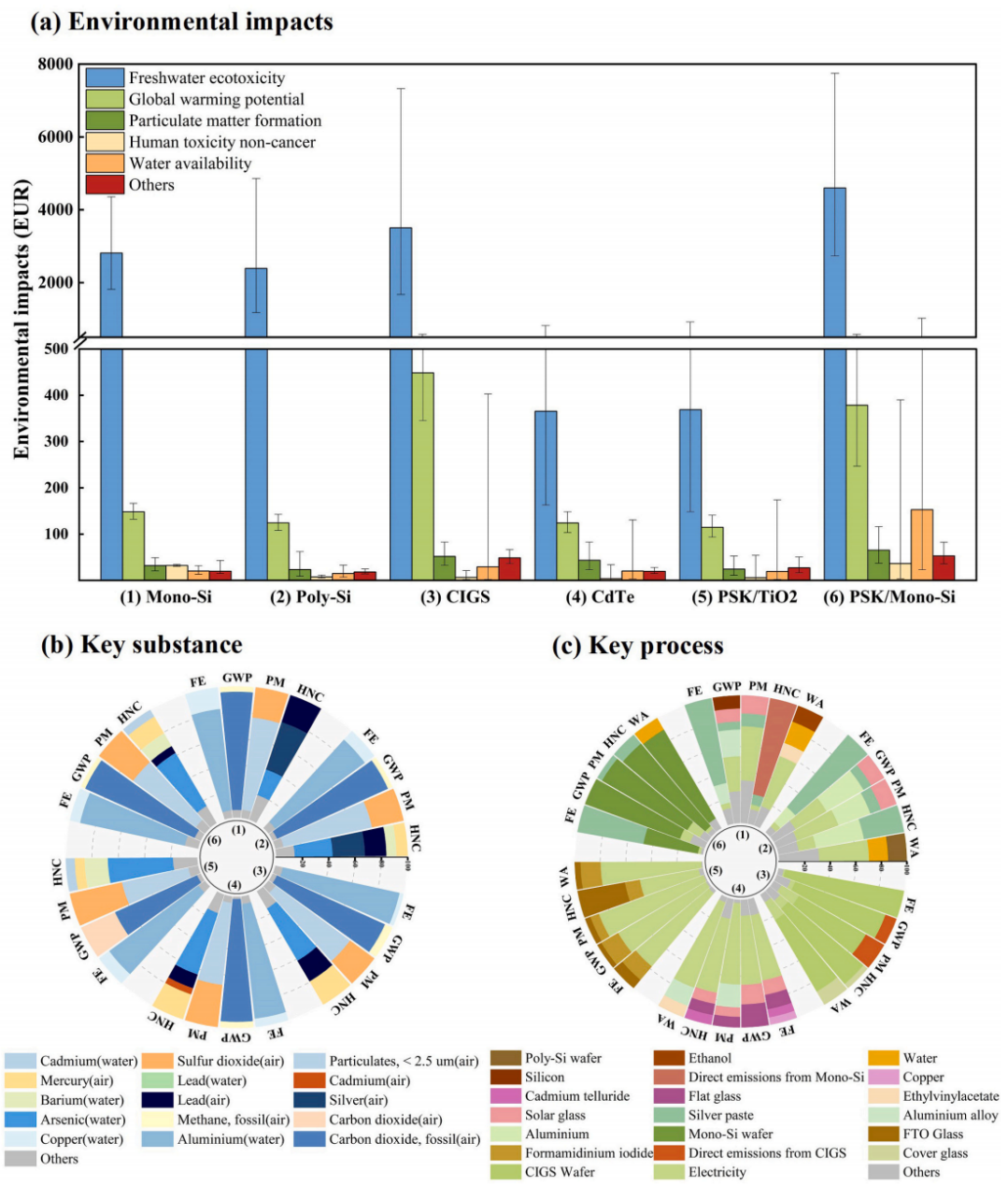
Fig. 2. Environmental impacts of different PV technologies by categories (a) key substances (b) and processes (c).
In addition, future technological advancements in PV, such as improved conversion efficiency, reduced material and energy inputs, increased collection and recycling rates, and a decarbonized power mix, could reduce the environmental impact intensities by 62.8 %-97.1 % (Figure 3). Total environmental impacts associated with installed PV capacity could decline by 81.7%-87.8% by 2050 compared to 2020 levels, with significant reductions in freshwater ecotoxicity.
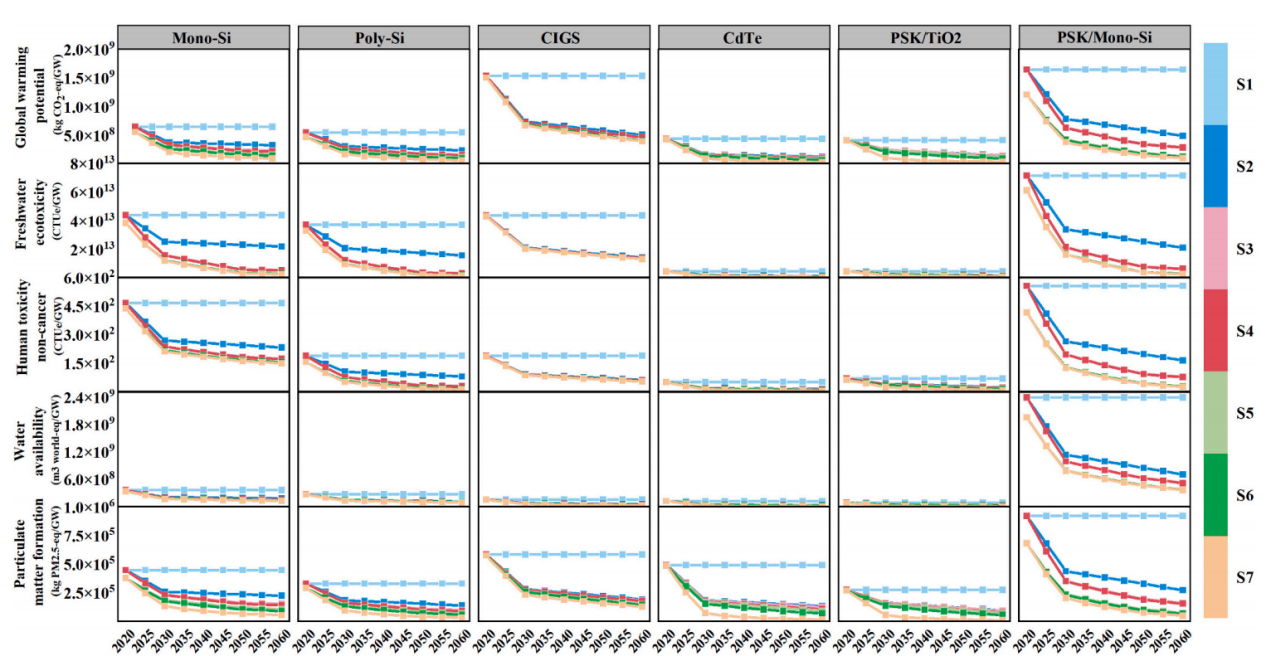
Fig. 3. Environmental impact intensities of different PV technologies.
By integrating an Integrated Assessment Model (e.g. GCAM) with PLCA, our study dynamically links climate targets, technological evolution, market transformation, and life cycle environmental impacts to explore the effects of perovskite PV technology on future PV deployment, market structure, and associated lifecycle environmental impacts. It provides a scientific basis for promoting the development of emerging PV technologies (perovskite PV) and the sustainable development of the PV industry.
This research is supported by the National Natural Science Foundation of China (72174111), the Taishan Scholar Youth Expert Program of Shandong Province (tsqnz20221106), and the Special Program of National Social Science Foundation of China (23VHQ018).
Full text link:https://www.sciencedirect.com/science/article/pii/S0195925525003543


 Address: No. 180 Wenhua West Road, Weihai City, Shandong Province, China
 Tel:+86-0631-5688246
 Email: whqyy@sdu.edu.cn

