A research team from the Institute for Blue and Green Development at Shandong University, in collaboration with the University of Maryland, the University of Adelaide, the Institute of Urban Environment at the Chinese Academy of Sciences, and Nanjing TODE Technologies Ltd has made significant progress in assessing the economic, resource, and environmental impacts of end-of-life (EoL) photovoltaic (PV) modules in China. Their findings, titled "Facilitating circularity of end-of-life photovoltaic in China with environmental benefits and costs informed by a high-resolution waste map", have been published in iScience, a journal under the Cell Press portfolio. Prof. Jiashuo Li of Shandong University is the sole corresponding author, and PhD candidate Chen Wang is the first author.
The rapid development and large-scale deployment of PV systems are critical to achieving China’s carbon peaking and carbon neutrality goals. In 2024, China’s installed PV capacity reached 886 GW and is projected to exceed 2,000 GW by 2050. Given that the typical lifespan of PV modules is 25–30 years, China is expected to face challenges associated with the decommissioning of large volumes of PV modules in the near future. As an emerging type of solid waste, decommissioned PV modules present both valuable resource potential and environmental risks. Improper disposal can result in resource losses, extensive land occupation, and environmental hazards such as heavy metal contamination of soil and water, posing multiple threats to ecological systems. To effectively address these resource and environmental challenges, there is an urgent need to understand the scale, spatial distribution, and material composition of EoL PV modules, and to comprehensively assess the benefits of alternative waste management strategies.
The study integrates multiple modeling approaches, including a high-resolution power system optimization model, the open-source Python-based PV ICE model (PV in the Circular Economy), life cycle assessment (LCA), and life cycle cost-benefit analysis. The researchers constructed a inventory of renewable energy power stations established between 2010 and 2019. Based on the power system model, they projected China's PV installation capacity up to 2050. Material intensity parameters (e.g., aluminum, silicon, silver, copper, and glass) and their dynamic evolution trends were also developed. From national, provincial, and point-level perspectives, the study offers a detailed and dynamic quantification of the scale and spatial-temporal patterns of PV waste generation and material recovery potential between 2020 and 2050. Multiple circular economy scenarios were designed to investigate how different waste management strategies influence the associated resource, environmental, and economic outcomes.
Key findings include the following:
● To achieve the 2°C climate target, China's PV capacity is projected to exceed 2,200 GW by 2050. This expansion would result in a dramatic increase in PV waste—by approximately 130 times—reaching 26 million tonnes by 2050, including both metallic and non-metallic materials.
● EoL PV hotspots are expected to first emerge in the northwest around 2034, and then spread to northern and eastern regions by 2040.
● Glass accounts for the largest share of module weight (68.8%) but contributes only 6.6% to the economic value.
● Recycling throughout the full life cycle of PV modules can generate substantial environmental benefits, with a potential reduction of 35–55 MtCO₂-equivalent emissions.
● However, the cumulative recycling cost may be considerable, ranging from USD 6.4 to 13.1 billion, depending on the chosen strategy.
The study underscores the importance of tailoring recycling policies to regional waste characteristics and recovery strategy profiles to support the sustainable development of China’s PV industry. At the national level, the authors recommend a comprehensive circular economy strategy, including improving recycling rates and extending product lifespans. At the provincial level, regionally differentiated strategies are encouraged: in the northwest, where decommissioning volumes are high, pilot recycling facilities should be prioritized. In cities such as Beijing and Shanghai, where waste volumes are lower, cross-regional cooperation may help achieve economies of scale in collection and processing. Moreover, the study highlights the need to focus on the recovery of high-value materials to enhance the economic viability of PV recycling.
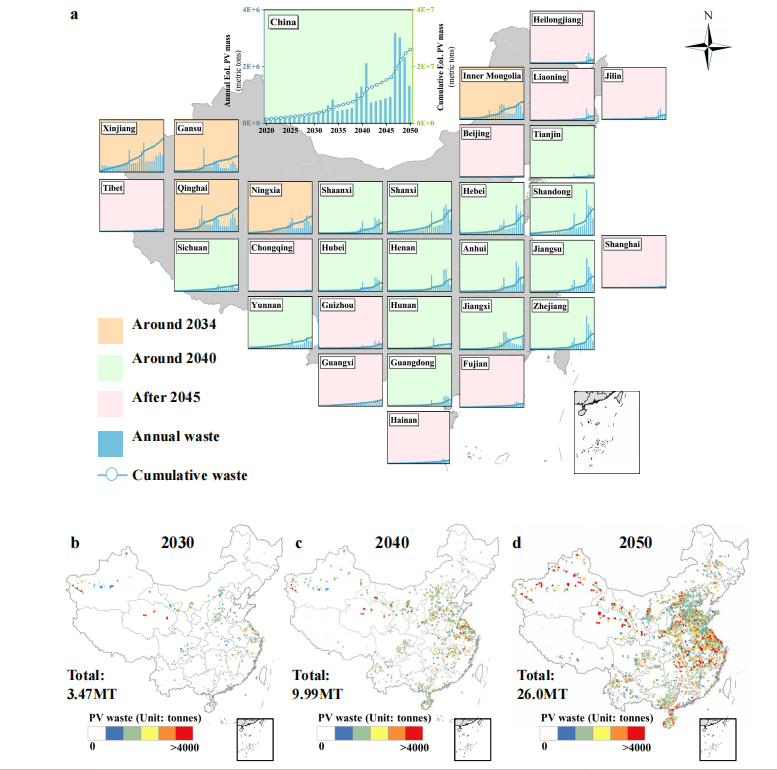
Figure 1.Uneven PV waste flows in China 31 provinces. (a) Cumulative and yearly decommissioning flows of PV during 2020–2050. The bar graph indicates the cumulative PV waste, and the dotted line graph indicates the annual PV waste. The background color of each province represents when the province became a PV waste hotspot area. (b)-(d) Spatial configurations of cumulative solar waste by 2030, 2040 and 2050 (grid cells with less than 1tons per 1 × 1 km are colored white, except for Taiwan region with no data).


 Address: No. 180 Wenhua West Road, Weihai City, Shandong Province, China
 Tel:+86-0631-5688246
 Email: whqyy@sdu.edu.cn

