Recently, Professor Zhao Xu from the Weihai Institute for Interdisciplinary Research of Shandong University and his collaborators published a paper titled "High-resolution mapping of CH4/N2O emissions from industrialization-related anthropogenic sources in China". Professor Zhao Xu is the co-first author of the paper, and master's student Yang Huiwen is a co-author.
China is the world's largest emitter of CH4and N2O, accounting for 17.88% and 16.67% of the global emissions respectively. Meanwhile, as the largest industrialized country, China has the most comprehensive industrial supply chain in the world. Its development inevitably leads to a large amount of energy consumption and the discharge of waste and wastewater. To achieve the carbon neutrality goal by 2060 and fulfill the net-zero emissions commitment set out in the United Nations Framework Convention on Climate Change, it is crucial to focus on reducing CH4and N2O emissions in industrial-related sectors such as energy, industrial processes and product use (IPPU), waste and wastewater. Therefore, it is urgently necessary to adopt more precise methods to quantify the CH4and N2O emissions of the above departments.
In this study, we provided a more detailed, point-source level bottom-up estimation of CH4and N2O emissions from industrialization- related anthropogenic sources from 2000 to 2022 at a 0.1°×0.1°spatial resolution. The contributions of these sectors to CH4and N2O emissions were quantified. The impact correlations among different departments and their spatio-temporal distributions have been clarified. The spatio-temporal hotspots and potential control measures in the emission process have been revealed. And potential mitigation policies were proposed from the perspective of GHG emissions. It provided data support for achieving the synergy among industrial development, industrial structure adjustment, and the carbon neutrality goal.
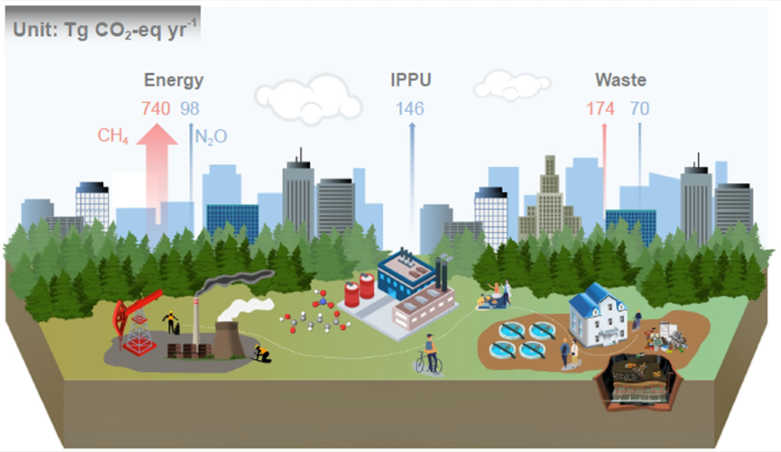
Fig. 1.CH4and N2O emissions from China’s industrialization-related anthropogenic sources including energy, industrial processes and product use (IPPU), and waste sectors in 2022.
This research was supported by the National Natural Science Foundation of China (42077111,72261147460,72074136) and other projects.
Full text link:
High-resolution mapping of CH4/N2O emissions from industrialization-related anthropogenic sources in China | National Science Review | Oxford Academic


 Address: No. 180 Wenhua West Road, Weihai City, Shandong Province, China
 Tel:+86-0631-5688246
 Email: whqyy@sdu.edu.cn

