Recently, the team led by Prof. Yu Yanni from the Weihai Institute for Interdisciplinary Research at Shandong University, published a research achievement titled “A comprehensive three-level meta-analysis of the positive discipline programme: effectiveness and moderating variables” in the English education journalEarly Child Development and Care, which reveals the effectiveness of “Positive Discipline”. Prof. Yu Yanni is the first author and corresponding author of the paper, and Master’s student Fang Jingwei is the co-first author. Other co-authors include Chen Huan, a doctoral student of the Institute.
How to educate and raise children correctly has always been an issue of continuous concern in China and across the world. “Positive Discipline” provides feasible and comprehensive guidance for parents and teachers. “Positive Discipline”, put forward by Dr. Jane Nelsen, offers insight into educating children in an innovative way which is, neither punitive nor permissive, and proposes using positive discipline every day with a kind and firm attitude. The aim of “Positive Discipline” is to teach young children to become responsible, respectful, and resourceful members of their communities and help them gain a sense of belonging in the long term.
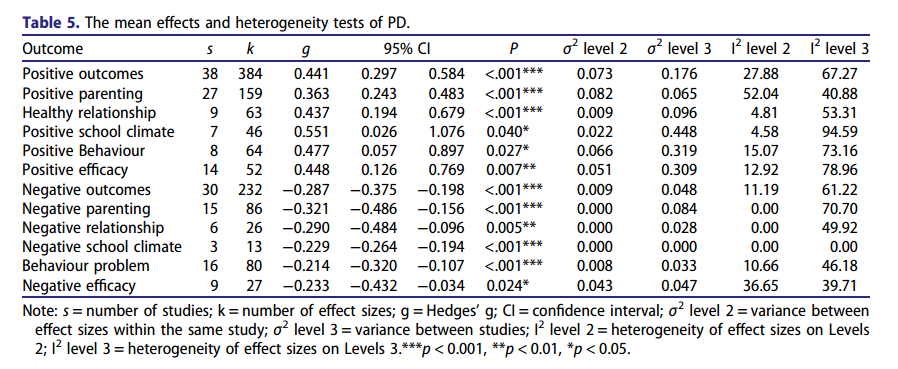
The research conducted a three-level meta-analysis of 616 randomized effect sizes from 45 studies. The results show that the “Positive Discipline” program helps improve caregivers’ parenting skills, promotes the interpersonal relationships between parents and children as well as teachers and students, builds a positive school atmosphere, alleviates children’s misbehavior, and enhances caregivers’ effectiveness. The intervention duration and investigative methodology moderate the intervention effect of “Positive Discipline” on negative outcomes. The optimal intervention duration for positive outcomes is less than 10 hours, while the optimal intervention duration for negative outcomes is 10-20 hours. Participants with a higher level of education showed more significant intervention effects during the intervention process. The “Positive Discipline” intervention is more effective in enhancing positive outcomes for caregivers of children under 8 years old, and it can improve negative outcomes for caregivers of children aged 8 and above. Compared with other intervention programs, “Positive Discipline” has a greater impact on promoting positive outcomes, but a smaller impact on alleviating negative outcomes.
Full text link: https://doi.org/10.1080/03004430.2024.2448678


 Address: No. 180 Wenhua West Road, Weihai City, Shandong Province, China
 Tel:+86-0631-5688246
 Email: whqyy@sdu.edu.cn

