On September 20, the research paper “Global spillover effects of the European Green Deal and plausible mitigation options” by Prof. Zhong Honglin’s research group from the Blue and Green Development Institute of Shandong University was published online inNature Sustainability, a journal underNature(open access URL:https://www.nature.com/articles/s41893-024-01428-1). Prof. Zhong Honglin is the first author of the paper, Prof. Sun Laixiang and Prof. Feng Kuishuang from the University of Maryland, and Prof. Klaus Hubacek from the University of Groningen are the co-corresponding authors. Shandong University is the first affiliated institution of the paper.
To address climate change, achieve regional sustainable development and biodiversity conservation, the European Union introduced the European Green Deal in 2019. However, the implementation of regulations related to agriculture, forestry, and biofuels in EGD policies will lead to an increase in the EU’s import demand for land-intensive commodities, which will have a severe impact on the ecological environment of importing countries. Therefore, it is necessary to assess its potential spillover effects and develop feasible mitigation measures before fully implementing EGD policies.
This study integrated international trade models (the Environmentally-Extended Multi-Regional Input-Output Model (EEMRIO) and the Physical Trade Model), the agricultural production model (the Global Agro-Ecological Zones (GAEZ) Model), and the land greenhouse gas emissions model (EX-ACT), and combined them with global biodiversity distribution data to to simulate the cultivated land expansion in EU importing countries resulting from EGD and the corresponding greenhouse gas emissions and biodiversity losses. It also proposed feasible measures in terms of agricultural production, agricultural products, and bioenergy consumption to mitigate its negative impacts. The main research results are as follows:
1.Assessment of the Spillover Effects of EGD:
If the agricultural, forestry, and biofuel-related policy targets of EGD in 2030 are implemented as scheduled, the agricultural land in EU importing countries will need to increase by 23.9 Mha (Figure 1) to make up for the shortfall caused by the decline in EU agricultural production. The expansion of agricultural land will trigger a (net) release of about 758.9 MtCO2-equivalent (CO2e) of GHGs and a biodiversity loss of 3.86 million mean species abundance loss (MSA-loss) outside the European Union, which is significantly higher than the 2030 carbon emission reduction target for the EU’s land and forestry sectors set by EGD (310 MtCO2-equivalent) and the ecological benefits brought by EGD’s import policies for eco-protective agricultural and forestry products (Figure 2).
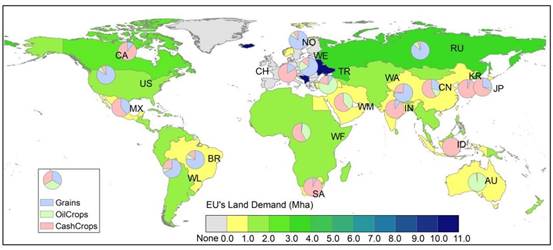 Figure 1. Additional cropland in EU importing countries under EGD scenarios (2020-2030)
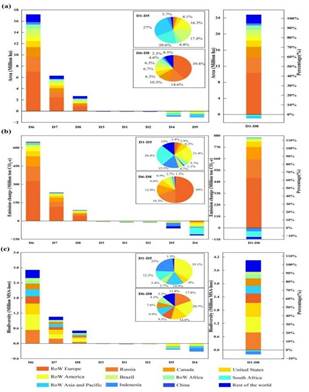
Figure 2. Outsourced cropland, GHG emissions and biodiversity loss under different EGD scenarios
2.Proposing Feasible Measures to Mitigate the Spillover Effects of EGD:
Three mitigation measures—substantially enhancing crop yield outside the European Union, phasing out all food-based biofuels, and adjusting the diets of EU residents—will reduce the demand for agricultural land by 11.68 Mha, reduce related greenhouse gas emissions by 400 MtCO2-equivalent, and slow down biodiversity loss by 4.26 million MSA (Figure 3).
Among them, shifting dietary patterns (reducing the consumption of animal-based foods) is the most effective mitigation approach, which will reduce the demand for agricultural land by 9.87 Mha, greenhouse gas emissions by 340 MtCO2-equivalent, and biodiversity loss by 4.17 million MSA. Phasing out food-based biofuels can significantly reduce agricultural land expansion, particularly deforestation, in ecological hotspots such as China and the United States. This measure is expected to reduce the planting area of bioenergy crops by 1.75 Mha, reduce greenhouse gas emissions by 65.27 MtCO2-equivalent, and reduce biodiversity loss by 90,000 MSA. Since the crop yields of most EU importing countries have reached the production levels under medium-intensity agricultural input, the measures to increase the crop yields of these countries have limited effects.
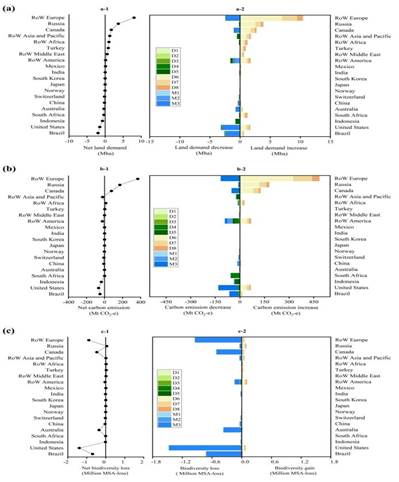
Figure 3. Outsourced land, GHG emissions and biodiversity loss under different EGD and EGD mitigation scenarios
This study constructed a comprehensive assessment framework for the spillover effects of global agricultural trade policies, quantified the spillover effects of agricultural, forestry, and biofuel-related policy measures in the European Green Deal on agricultural land, greenhouse gas emissions, and biodiversity, proposed three measures to mitigate its spillover effects and conducted a benefit assessment. In addition, this study can further provide more detailed and accurate information on the spatial layout of land use changes and their ecological and environmental impacts for relevant policy-making, and will provide methodological models and scientific bases for the formulation of relevant policies for regional and global ecological and environmental sustainable development.
Prof. Christina Prell from the University of Groningen, Associate Prof. Shan Yuli from the University of Birmingham, Researcher Benedikt Bruckner from the Potsdam Institute for Climate Impact Research in Germany, Ph.D. student Li Yanxian from the University of Groningen, and Ph.D. student Ding Jiaying from the Blue and Green Development Institute of Shandong University participated in this research. This study was funded by the National Natural Science Foundation of China (72174111, 72033005), the Taishan Scholar Youth Expert Program of Shandong Province (tsqnz20221106), and the Major Grant of the National Social Science Foundation of China (24VHQ018).
Open-access URL:https://www.nature.com/articles/s41893-024-01428-1


 Address: No. 180 Wenhua West Road, Weihai City, Shandong Province, China
 Tel:+86-0631-5688246
 Email: whqyy@sdu.edu.cn

