A research team led by Prof. Ning Zhang from the Institute of Blue and Green Development at Shandong University, Weihai, in collaboration with The Hong Kong Polytechnic University, has recently published a research article inHeliyon, a journal under the renownedCell Press. The paper, titled“Climate change and tourism demand: Risks for extreme heat?”, explores how rising temperatures affect tourism in China. The first author of the paper is PhD student Dingyi Chang, and Professor Zhang serves as the corresponding author.
With global temperatures steadily increasing, extreme heat has become a growing challenge for the tourism industry. Accurately estimating how extreme temperature affects tourism activities is crucial for understanding the broader impacts of climate change and for designing effective adaptation policies. To address this issue, the paper collected daily weather and tourism data from 280 cities across China between 2005 and 2019. This large-scale, fine-grained dataset allowed to construct China’s first nationwide “temperature-tourism response function.”
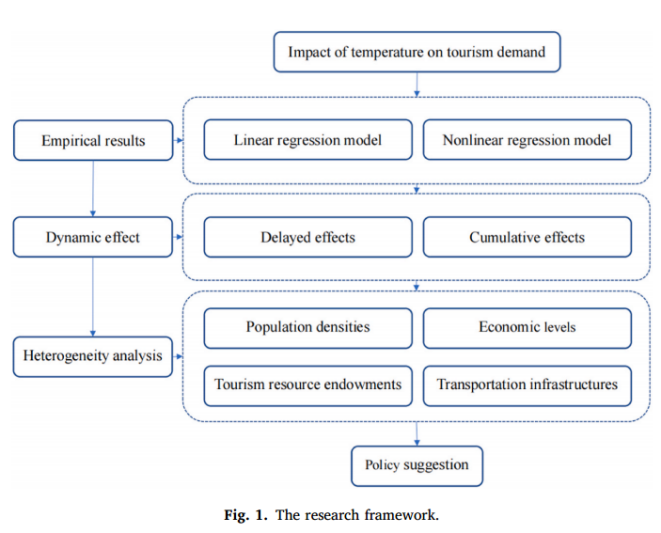
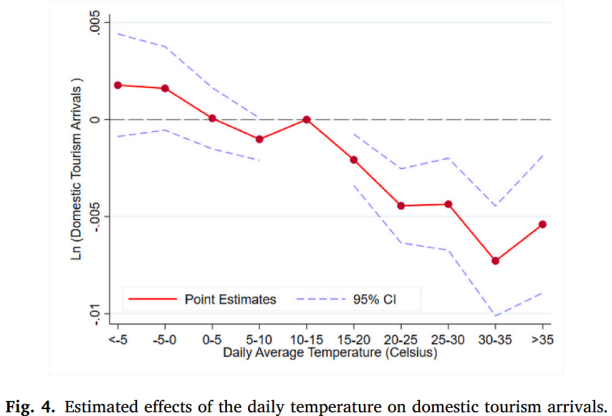
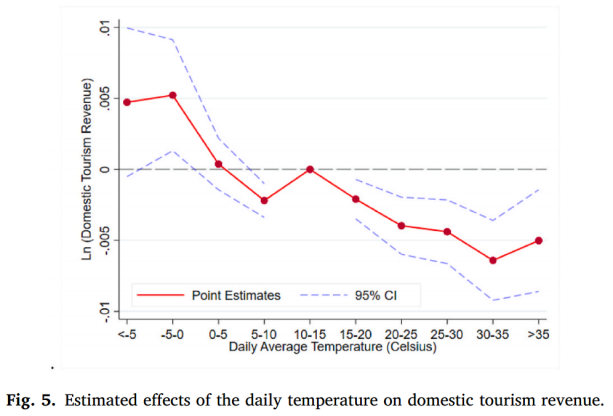
Extremely high temperatures have become a major hurdle to tourists’ experiences in various destinations. In this study, we present the first nationwide estimation of the temperature-tourism response function using a fine-grained panel dataset constructed by matching tourism data and daily meteorological datasets for 280 cities from 2005 to 2019 in China. Results show a non-linear relationship between temperature and tourism employing the temperature bins method, which is not sensitive to response equations. In addition, we conduct a rich heterogeneity analysis in the article to further analyse the effects of other external conditions on the temperature-tourism relationship, including the destination’s level of tourism economic development, population, infrastructure development, and tourism resource endowment. We also observed that increasing summer temperatures result in decreased tourism arrivals and revenue, while rising autumn temperatures lead to increased tourism arrivals and revenue. This research contributes to a deeper understanding of the complex relationship between temperature dynamics and tourism patterns, offering insights into destination management and adaptation strategies.
Article:https://doi.org/10.1016/j.heliyon.2024.e37186


 Address: No. 180 Wenhua West Road, Weihai City, Shandong Province, China
 Tel:+86-0631-5688246
 Email: whqyy@sdu.edu.cn

