Professor Zhang’s team at the Weihai Institute for Interdisciplinary Research has published a research paper titled “Energy Trade Access and Market Monopoly: Evidence from China’s Power Sector” inWorld Development, a leading journal in the fields of economics and development studies, uncovering market power losses of Chinese power sector in energy trade. The first author of this paper is doctoral candidate Yu Zhao from the institute, and Professor Ning Zhang is the corresponding author.
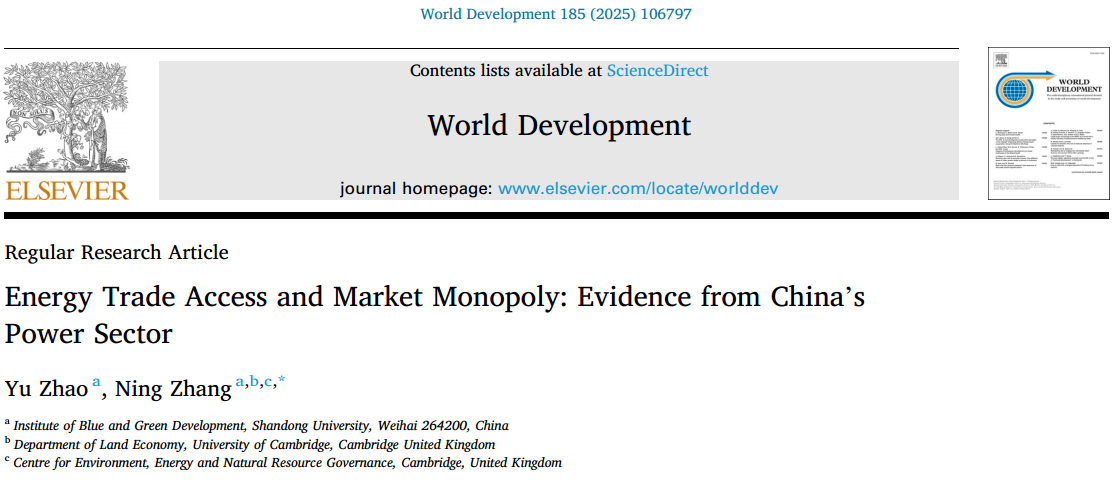
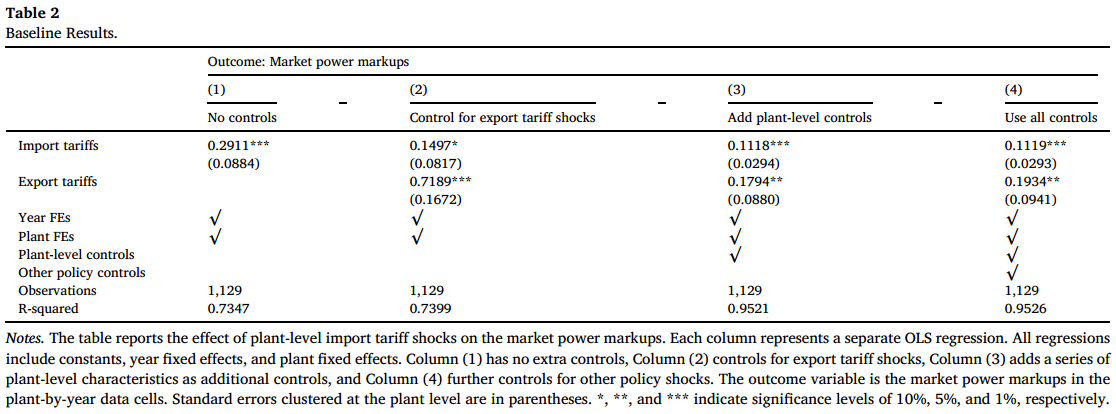
This paper theoretically and empirically investigates the effect of energy trade access on the monopoly power of China’s power sector. We construct plant-level import and export tariff shocks, and calculate the market power markups through the joint estimation of the restricted cost function and the inverse supply relation. Exploiting the variations in plant-level tariffs, we find that a 1% cut in energy import tariffs leads to a decrease in market power markups by 10.54%. This effect is driven by a combination of a price drop in the product market and reduced marginal cost in the input market. However, the declines in marginal cost are small relative to the falls in prices, due to trade-induced increases in capital demand (and prices) partially offsetting the savings in energy cost. By identifying additional potential channels, we validate the presence of the classical Ricardian effect and the Schumpeterian effect. Our results demonstrate that import tariff reductions result in substantial net trade gains.
This research was supported by the National Natural Science Foundation of China (Grant No. 72033005), and the Major Projects of the National Social Science Fund of China (Grant Nos. 23VRC037 and 24VHQ018), etc.
Full-text available at:https://doi.org/10.1016/j.worlddev.2024.106797


 Address: No. 180 Wenhua West Road, Weihai City, Shandong Province, China
 Tel:+86-0631-5688246
 Email: whqyy@sdu.edu.cn

