The Scientific Intelligence Research Team at the Weihai Institute for Interdisciplinary Research, Shandong University has published research findings titled "Giant Undulations Driven by Pitch-Angle Scattering of Time Domain Structures Modulated by Plasmapause Surface Wave" in the top journal in the field of space physics, Geophysical Research Letters. This work reveals the physical mechanism by which plasmapause surface waves (PSWs) drive giant auroral undulations (GUs). The first author of the paper is postdoctoral researcher Yi-Jia Zhou, with Professor Jian Liu and Professor Quan-Qi Shi from the School of Space Science and Technology as key collaborators. Shandong University is the first affiliation.
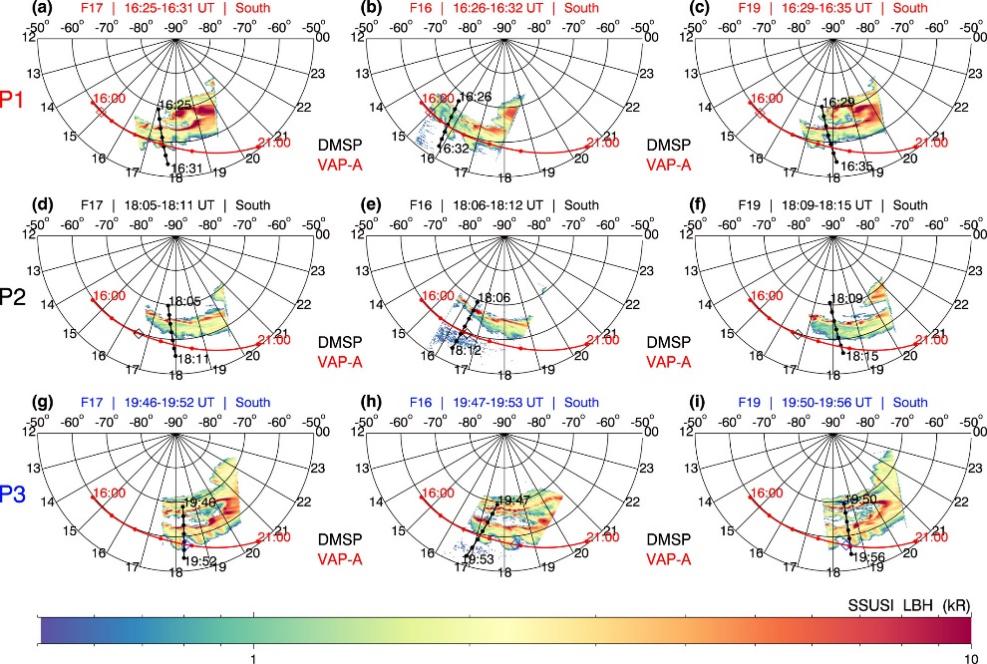
Figure 1.Giant aurora undulations in the south hemisphere shot by DMSP F17, F16, and F19 satellites. The trajectories of DMSP (black) and VAP-A (red) satellites are overlapped with 1 min and 1 hr intervals, respectively. The aurora imaging times are labeled on the top of each panel. The footprint trajectory of VAP-A during 16:00–21:00 UT is obtained by the Tsyganenko 96 (T96) magnetic field model projection, with diamonds representing the VAP-A footprint location at moments of each aurora imaging. P1 (16:30–17:30 UT), P2 (18:00–18:50 UT), and P3 (19:30–20:15 UT) mark three periods of distinct magnetospheric particles and waves signatures by VAP-A, which can be detailed in the context. The auroras on the same row were shot within a 10 min period, separately falling into the P1, P2, and P3 periods.
The research team, through analysis of conjugated magnetosphere-ionosphere observational data during a moderate geomagnetic storm, discovered that giant auroral undulations are directly excited by the pitch-angle scattering and precipitation of thermal electrons and ions with energies below 1 keV, as well as energetic ions up to tens of keV. The flux and energy of the scattered electrons and ions over one surface wave period determine the scale and brightness of the giant auroral undulations. The study further indicates that this periodic electron scattering and precipitation is caused by periodic time domain structures modulated by plasmapause surface waves.
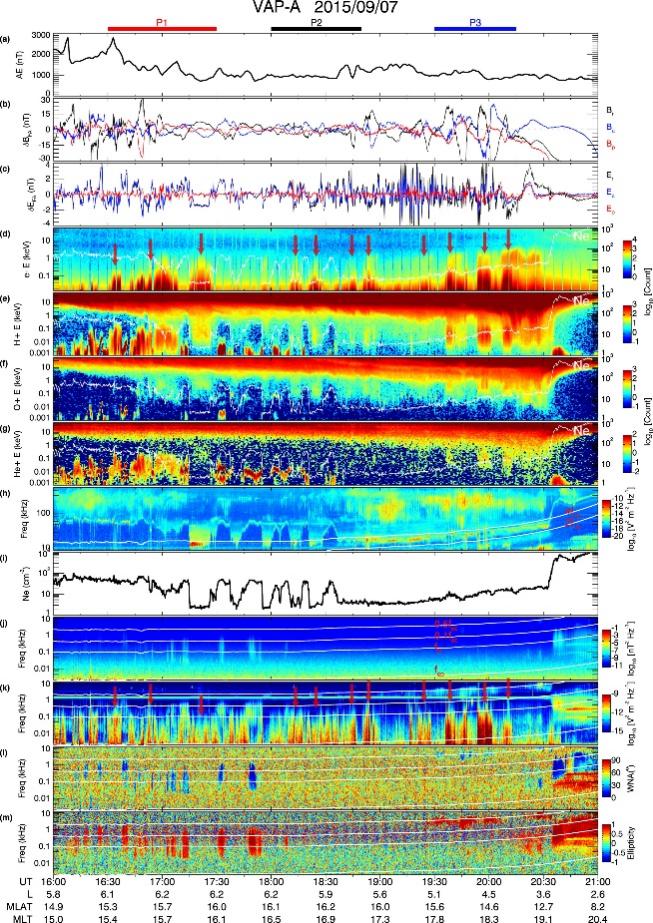
Figure 2.In situ waves and particles characteristics during 16:00–21:00 UT measured by VAP-A satellite. (a) AE index; (b–c) ULF wave magnetic and electric field detrended by the 30 min smooth average; (d–g) energy spectrograms of omnidirectional electron, proton (H+), oxygen ion (O+) and helium ion (He+); (h–i) high frequency spectrogram of electric field and electron density inferred from the upper hybrid resonance frequency; (j–m) frequency-time spectrograms of magnetic and electric spectral density, wave normal angle (WNA), and ellipticity. The electron density in panel (i) is also superimposed on panels (d–g) as white curves. The white lines denote 4fce, 2fce in panel (h), and 0.5fce, 0.1fce, flh, fcp in panels (j–m), where fce (fcp) is electron (proton) cyclotron frequency and flh is lower hybrid resonance frequency. Three thick lines labeled as P1 (16:30–17:30 UT; red), P2 (18:00–18:50 UT; black), and P3 (19:30–20:15 UT; blue) highlight three periods of different magnetospheric particles and waves signatures. Red vertical arrows in panels (d) and (k) mark the correspondence between TDSs and thermal electron enhancement. Subscript: p-parallel; r-radial; a-azimuthal.
In summary, the duskside plasmapause surface waves modulate the intensity of time domain structures, periodically scattering and precipitating particles, ultimately forming giant auroral undulations in the ionosphere. This physical mechanism differs significantly from predictions in previous studies, revealing the complex physical processes behind the plasmapause surface wave-giant auroral undulations phenomenon. The research builds a bridge of physical mechanisms connecting plasmapause surface waves and ionospheric giant auroral undulations, highlighting the key role of plasmapause surface waves in magnetosphere-ionosphere coupling and space weather.
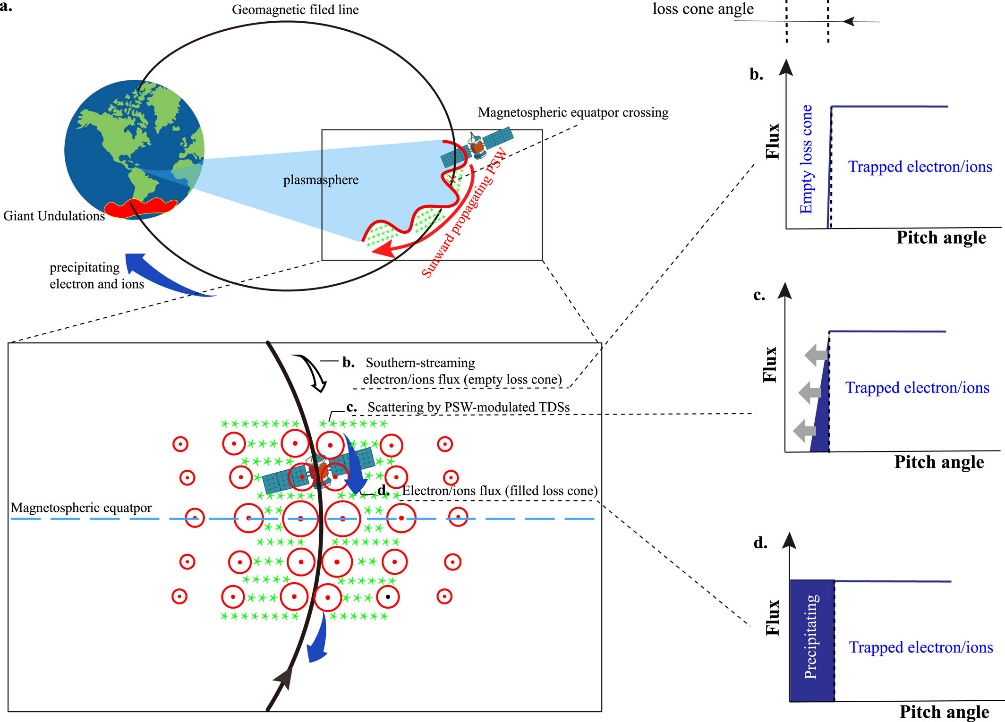
Figure 3.Schematic of electron and ions scattering by the PSW-modulated TDSs, resulting in GUs. (a) The open/filled blue arrow represents southward streaming electrons and ions with the empty/filled loss cone (b)/(d) before/after the PSWs-modulated TDSs interact with them (c) (pitch-angle scattering by waves). The spacecraft location is denoted by a black filled circle. (b–d) The evolution of the electron PAD. The red symbols⊙represent the sunward propagating PSWs with the size of circles denoting the intensity of PSWs. And green asterisks * denote the TDSs modulated by PSWs.
This work was supported by the National Natural Science Foundation of China (42222408, 42441809), the National Key R&D Program of China (2021YFA0718600) and the Youth Innovation Promotion Association of the Chinese Academy of Sciences (No.Y2021027).
Original link:https://agupubs.onlinelibrary.wiley.com/doi/10.1029/2024GL111782.
As an emerging interdisciplinary field with the deep integration of artificial intelligence and basic science, scientific intelligence accelerates scientific discovery, solves complex scientific problems, drives paradigm change in scientific research, and promotes the sustainable development of artificial intelligence through discipline integration. Scientific intelligence has shown unique advantages and broad prospects in dealing with complex system problems, and has important value for basic research and major applications. In various basic research fields such as mathematics, physics, computational science, chemistry, and biology, as well as strategic application directions such as fusion energy, deep space exploration, and advanced manufacturing, scientific intelligence has received more and more attention. Many national big science installations and international big science programs are actively promoting the construction of digital and intelligent platforms. From the perspective of both material science and information science, scientific intelligence is the frontier direction of vigorous development.


 Address: No. 180 Wenhua West Road, Weihai City, Shandong Province, China
 Tel:+86-0631-5688246
 Email: whqyy@sdu.edu.cn

