Recently, the Weihai institute for interdisciplinary research team of Shandong University, in collaboration with multiple research teams both domestically and internationally, has made advancements in climate cost-effectiveness for non-carbon dioxide emissions reduction. The related achievement, titled "Opportunities beyond net-zero CO2 for cost-effective greenhouse gas mitigation in China" has been published online in Science Bulletin as a research paper. Professor Peipei Tian and Professor Kuishuang Feng from the University of Maryland are co-corresponding authors of the paper, and doctoral student Kang Yating is the first author of the paper. Other co-authors include Professor Jiashuo Li from Shandong University and Professor Klaus Hubacek from the University of Groningen.
Achieving net-zero CO2 emissions is the current focus of China’s carbon neutrality. However, non-CO2 greenhouse gases (GHGs) are more powerful climate warmers, making their emission reduction an opportunity to rapidly mitigate future warming. Here, we evaluate non-CO2 mitigation potentials, costs and climate benefits in the context of China’s carbon neutrality goals by 2060. The assessment is conducted by coupling the integrated assessment model GCAM with a climate emulator. The findings indicate that mitigation technologies can largely reduce fluorinated gas emissions from industrial sectors, but long-term non-CO2 reductions of energy sector activities rely heavily on fuel switching. Furthermore, the cumulative costs of deploying non-CO2 mitigation technologies are projected to be less than 10% of the total costs of achieving carbon neutrality from 2020 to 2060. If non-CO2 mitigation measures are included in the overall mitigation portfolio, the benefits of avoided warming would by far outweigh the total mitigation cost increase. Our results thus highlight that incorporating a wider suite of GHGs into climate change strategies can enhance the cost-effectiveness of mitigation efforts.
This study was supported by the National Key Research and Development Program (2022YFC3105304), the National Natural Science Foundation of China (72303136), and the Shandong Provincial Natural Science Foundation (ZR2023QG002).
Link:https://doi.org/10.1016/j.scib.2024.08.012
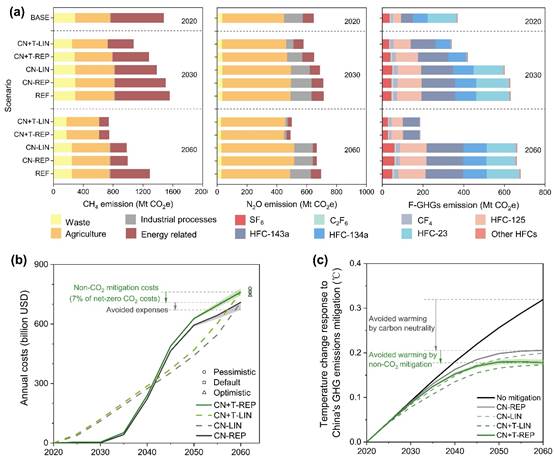
Figure 1 Potential, cost, and climate benefits of non-carbon dioxide emissions reduction in China


 Address: No. 180 Wenhua West Road, Weihai City, Shandong Province, China
 Tel:+86-0631-5688246
 Email: whqyy@sdu.edu.cn

