Professor Yanni Yu's research team from our institute has published a groundbreaking study titled "Does Climate Change Exacerbate Gender Inequality in Cognitive Performance?" in the top-tier environmental science journalGlobal Environmental Change. This research uncovers how extreme heat exposure amplifies gender disparities in cognitive performance. PhD student Huan Chen at Weihai Institute for Interdisciplinary Research, Shandong University is the first author, with Professor Yu serving as corresponding author.
Climate change is not only a scientific and technical issue but also encompasses sociocultural dimensions. It involves underlying concerns related to rights, income distribution equity, and the ownership of resources. Socioeconomically disadvantaged populations often experience the compounded effects of factors such as income, wealth, gender, education, and race, making them particularly vulnerable to the consequences of climate change.An expanding body of research highlights how different genders experience varying levels of vulnerability and exposure to climate change impact. Indeed, if women and men were equally exposed to climate change and had equivalent incomes and resources, women might exhibit greater adaptability in certain aspects of responding to climate change. Although a large number of studies have shown that high temperatures have an impact on human cognitive performance, there is a relatively lack of research on the effect of high temperatures on gender differences in cognitive performance.
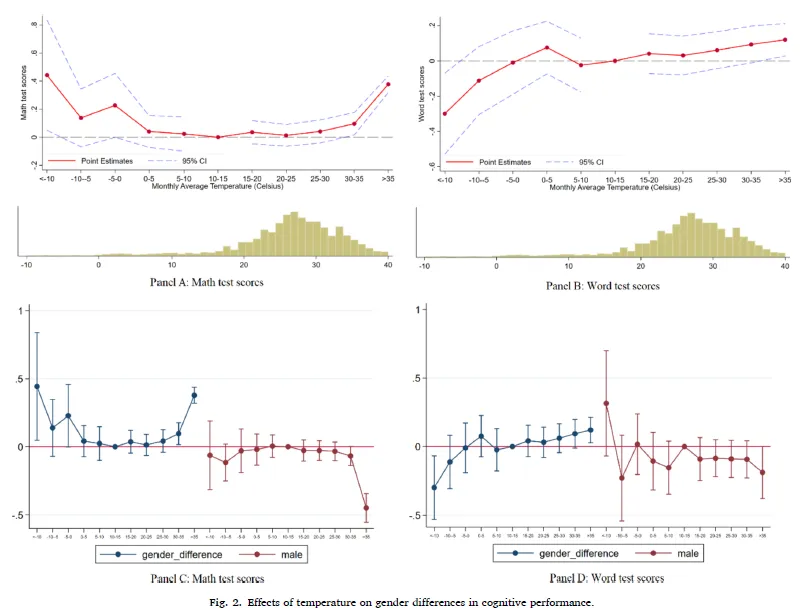
This paper leverages nationally representative data from China to gain additional insights by assessing how temperature affects cognitive performance across genders. This paper shows that for cognitive performance, women have a stronger ability to adapt to temperature changes, especially extremely high temperatures.An additional day of temperature above 35°C increases women's math test scores and word test scores by 0.38 and 0.12 standard deviation (relative to men), relative to an additional day of temperature between 10-15°C. Several robustness tests justify this finding. The mechanism analysis found that women are better able to cope with climate change mainly in remembering and applying, rather than in understanding. Sleep and mental health also indirectly affect the gender differences. Further heterogeneity analysis shows that compared with rural areas, wealthy households, young adults and hot counties, the gender differences in the impact of temperature on cognitive performance are greater in the urban areas, poor households, seniors, and cold counties. These findings in this paper provide important policy notes for gender equity in schooling and allocative efficiency in the labor market. Additionally, it holds significant implications for understanding the resilience of women in coping with and adapting to climate change, thereby contributing to the promotion of female participation in climate change decision-making.
This work is supported by National Natural Science Foundation of China (NSFC) (grant number 72022009 and 72473083).
Original download link:
https://www.sciencedirect.com/science/article/pii/S0959378024001456


 Address: No. 180 Wenhua West Road, Weihai City, Shandong Province, China
 Tel:+86-0631-5688246
 Email: whqyy@sdu.edu.cn

