Against the backdrop of the severe global climate change, climate and energy finance has become an important topic for promoting sustainable development. With the rise of global temperatures and the frequent occurrence of extreme weather events, governments, enterprises, and all sectors of society around the world have recognized the urgency of mitigating climate change, promoting energy transition, and driving the development of a low-carbon economy through financial means.
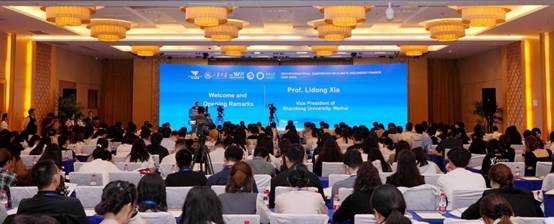
On the morning of June 1, the 2024 International Conference on Climate and Energy Finance (ICEF2024), hosted by the Energy Finance Professional Committee of the International Society for Energy Transition Studies and the Climate Finance Research Branch of the Chinese Society of Optimization, Overall Planning and Economic Mathematics, and organized by the Weihai Institute for Interdisciplinary Research at Shandong University, successfully opened in Weihai. With the theme of "Challenges and Opportunities for Energy and Climate Finance in Global South", the conference attracted more than 400 experts and scholars from over 100 well-known universities and research institutions worldwide, including the Chinese Academy of Sciences, Peking University, Tsinghua University, Beihang University, Fudan University, Renmin University of China, The Hong Kong University of Science and Technology, City University of Hong Kong, Macau University of Science and Technology, the National University of Singapore, the University of Bristol in the UK, and Kyushu University in Japan. They jointly discussed the new challenges, issues, opportunities, and achievements in the development of climate and energy finance in global south countries against the backdrop of climate change.
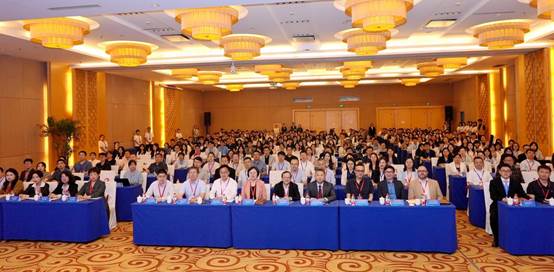
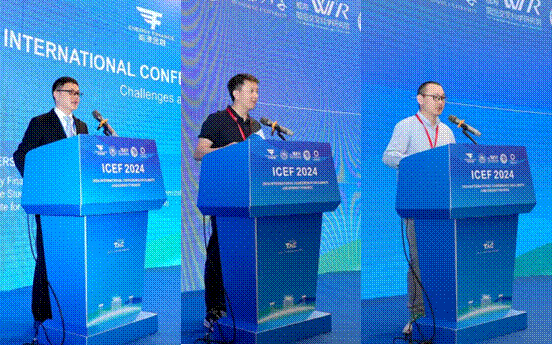
Xia Lidong, the member of the Party Working Committee and Vice President of Shandong University,Weihai, and Zhang Dayong, Chairman of the Climate Finance Research Branch of the Chinese Society of Optimization, Overall Planning, and Economic Mathematics, attended the opening ceremony and delivered speeches. Ji Qiang, a researcher at the Institute of Science and Development, Chinese Academy of Sciences, and others also attended. Li Jiashuo, the academic research leader of the Weihai Institute for Interdisciplinary Research at Shandong University, Dai Hancheng, Director of the Department of Environmental Management at Peking University and Head of the Office for Energy and Environmental Policy Research, and Wang Hui, Deputy Dean of the Institute for Energy Economics and Policy at China University of Petroleum (East China), presided over the opening ceremony.
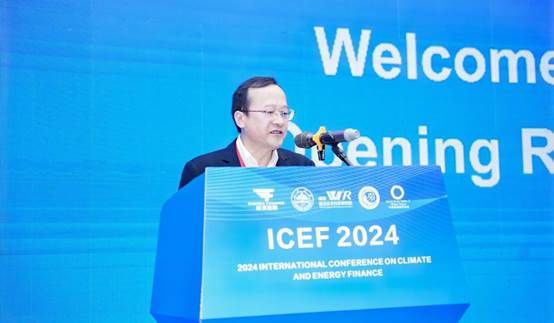
Prof. Xia Lidong stated that as a university with origins in modern higher education in China and a university under the "Double First-Class" initiative, Shandong University has made significant contributions to the national and regional economic and social development. As a multi-disciplinary, open, and comprehensive campus jointly established by Shandong University and Weihai City, the Weihai campus, on the occasion of its 40th anniversary, adheres to characteristic leadership and connotative development, focuses on major national needs such as sustainable development and the green and low-carbon transformation of the economy, and promotes the exploration of frontier sciences and the integration of disciplines. Currently, the world is facing severe challenges of climate change, and green finance is an important way to accelerate energy transition and achieve the goal of carbon neutrality. It is hoped that taking this conference as an opportunity, academic exchanges will be strengthened, innovative inspirations will be stimulated, and the research and practice in the field of global climate and energy finance will be effectively promoted.
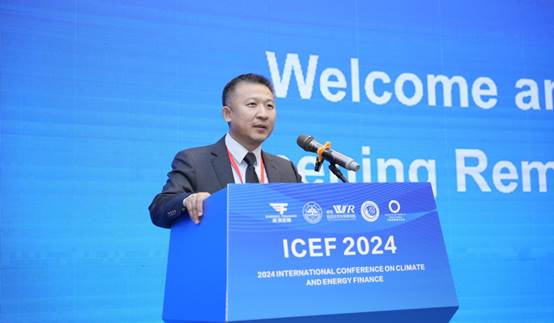
Zhang Dayong said that it has become a broad consensus that climate change is related to human well-being and the future, which provides great opportunities for the development of climate and energy finance. However, the continuous increase of global geopolitical risks also brings new challenges to addressing climate change. This conference brings together experts and scholars from multiple disciplines and fields, offering suggestions for promoting the energy transition in global south countries and achieving sustainable development goals, fully reflecting the significance of the International Conference on Climate and Energy Finance. The International Conference on Climate and Energy Finance has entered its seventh year, and it is committed to providing a high-level communication platform for global experts and scholars to promote cooperation, exchanges, and knowledge sharing. He also highly praised the contributions of the scholars and institutions participating in the conference and expressed gratitude for their long-term attention and support for the development of climate and energy finance.
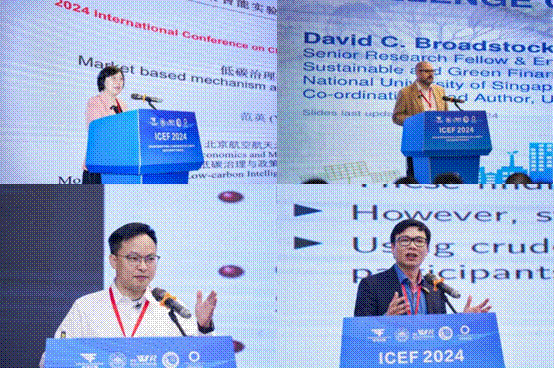
During the keynote report session by invited experts, Professor Fan Ying from Beihang University introduced the market mechanism of low-carbon governance, revealed the carbon reduction effect of the carbon emission trading system, and analyzed the impact of different mechanism designs and market forces on cost-effectiveness and social welfare, as well as the intertemporal allocation mechanism of emission permits. Professor David Broadstock from the National University of Singapore introduced the long-term challenges of transformation, reallocation cooperation, and externality pricing, and pointed out that some governments have begun to pay attention to the financing challenges of energy transition, but international investors still face great difficulties in evaluating and comparing various challenges. Professor Zhang Bing from Nanjing University of Finance and Economics introduced the application of machine learning in the precise positioning of environmental law enforcement targets. The research shows that machine learning technology can significantly improve the detection rate of violations, save inspection resources, and avoid the disadvantages of pure data-driven target positioning by combining random inspections and targeted inspections. Professor Duc Khuong Nguyen from EMLV Business School in France introduced the common driving factors of commodity futures and discussed the predictive ability of factors such as equity returns, financial hedgers, and macro uncertainties on the returns of commodity futures at different stages.
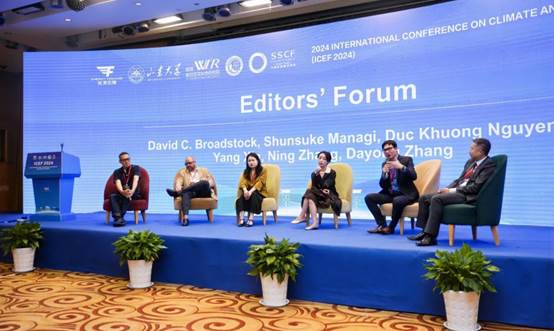
Subsequently, Professor David Broadstock from the National University of Singapore, Professor Shunsuke Managi from Kyushu University in Japan, Professor Duc Khuong Nguyen from EMLV Business School in France, Xia Yang, an editor of the journal Nature, Luo Xian, an editor of the journal Green and Low-Carbon Economy, and Zhang Dayong, Chairman of the Climate Finance Research Branch of the Chinese Society of Optimization, Overall Planning and Economic Mathematics, jointly participated in the Chief Editors' Forum. They discussed the current main issues, development trends, and challenges in climate and energy finance, discussed the significance of academic paper publication and the precautions for submitting interdisciplinary papers, and shared their valuable experiences and practices with their peers.
The ICEF conference set up 48 thematic sub-forums, conducting in-depth discussions on topics such as artificial intelligence and digital transformation, carbon neutrality, climate change, energy transition, pollution prevention and control, Sustainable Development Goals (SDGs), environment, social and governance (ESG), green finance, and environmental and ecological regulations. The aim is to build a high-end international academic exchange platform in the field of climate and energy finance, promote the development of climate and energy finance disciplines at home and abroad, enhance the representativeness and voice of the "Global South" in global governance, explore new ideas, methods, and practices for implementing "South-South cooperation", and provide new impetus and support for China to address global climate change and participate in global climate governance.
The ICEF conference was initiated in 2018 and has been successfully held in cities such as Beijing, Kunming, Qingdao, Xiamen, Nanjing, and Changsha, attracting experts and scholars from more than 200 universities in more than 20 countries and regions to participate in exchanges. It has been selected into the "Guide to Important Academic Conferences" of the China Association for Science and Technology for four consecutive years, playing an important role in promoting the development of climate and energy finance disciplines and talent cultivation in China.
This conference was specifically organized by the Weihai Institute for Interdisciplinary Research at Shandong University. The TIERS team of Southwest University of Finance and Economics, the Institute of Science and Development, Chinese Academy of Sciences, and the Business School of Shandong University co-organized the conference.


 Address: No. 180 Wenhua West Road, Weihai City, Shandong Province, China
 Tel:+86-0631-5688246
 Email: whqyy@sdu.edu.cn

